 Return to micahmaxwell.com
Rooms that need the truth named, not a motivational lap.
I speak to leaders who look settled from the outside and are privately circling a decision their success has protected them from. I do not tell them what to decide. I hand them a way to see the call clearly before it gets made for them.
Start the conversation You will hear back within two business days, with a straight answer on whether I am the right fit.Your room
Default verdict.
Default prescription.
Default timing line.
Most leadership talks are built for the leader who is failing. Mine are built for the one who is not.
The job still fits on paper. The income holds. The relationships hold. From the outside the structure looks like success.
From the inside, the person who built it is no longer the person who has to keep leading it.
I call that gap the Stability Illusion. It is the belief that protecting what you built is safer than changing it, even after protecting it has started to cost more than change would. It is not irrational. You built something real. That is exactly what makes it so hard to see.
Every year it waits, the price goes up. The money, the reputation, and the people around a leader all organize themselves around the structure nobody has questioned.
"I finally have words for this."
the feedback I get most, and the one I work forFive moves. Run them on one sentence.
This is what a leader in your room says out loud. The five buttons are the Decision Path Method, the framework at the center of my book. Press them in order.
That is the talk, compressed. In the room it runs 45 minutes, and every person writes their own first sentence before they leave. Not a pep talk. A path.
When my father died, I inherited his library.
Not a room. Stacks of books. Norman Vincent Peale, Napoleon Hill, Og Mandino, Les Brown, stacked beside his bed for as long as I can remember. He read about the life he wanted at night, after the job that paid the bills. The business never got built. The dream was still in the books, underlined and circled, carried all the way to the end.
I have met a lot of leaders like him since. Respected. Capable. Successful by every outside measure. And quietly carrying a decision they have not let themselves name.
So here is what I do with a room, in plain terms: I hand people a way to look at the decision they have been avoiding, before it gets made for them.
What a motivational lap does
- Borrows energy the room did not earn
- Leaves by Tuesday
- Tells them to push harder or blow it up
- Never names the actual decision
What this does
- Names the thing the room has been circling
- Gives them a structured way to look at it
- Ends with a sentence they wrote themselves
- Trusts them to make their own call
The best feedback I get is not "that was inspiring." It is "I finally have words for this."
Two programs. Both adjusted to the room.
A keynote for a large room and a workshop for a small one. Send me who is in the seats and what they are carrying, and I will tell you which of these fits, or whether neither does.
For most rooms the keynote leads and the workshop follows for the team that wants to go deeper.
The Father's Library
Keynote · 45 minutes · 60 with Q&A · in person or virtualA talk about the decision you keep not making, and what it costs to carry it. The room walks the Decision Path Method, the five moves at the center of Decision Point: Gap, Trace, Frame, Signal, Move.
- Language for what they have been calling burnout or restlessness
- The five moves, in order, with the reason each one is there
- One sentence, written before they leave, that names the decision
The Stability Illusion
Workshop · 90 minutes · 12 to 25 people · in person or virtualAn audit for leaders who cannot tell whether they are stable or just still standing. Three blocks, and the room writes after each one: the Logic of Staying, the Hidden Ledger, and Stable or Still Standing.
- The structure they are protecting, named in one sentence
- What staying has already cost, entered on the other side of the book
- One specific step with a date on it, completed live
How booking works
Reach out
Tell me about the event, the audience, and the date, at the bottom of this page. You hear back within two business days.
A short call about the room
Twenty minutes. Who is in the seats, what they are carrying, what the event is for. I tell you which program fits, or that neither does.
Agreement and date
A one-page agreement, the date on both calendars, and a pre-event questionnaire so the talk is built for your room, not the last one.
Event day
I arrive early, I do not run over, and every person leaves with a sentence they wrote themselves. Within 48 hours you get a short note and a two-question evaluation.
Not notes. A completed page.
Language
Words for what they have been calling burnout, restlessness, or "a season." Most of the room has never heard the Stability Illusion named. They recognize it in the first ten minutes.
A method they can run again
Five moves with names. The Decision Path Method works on the decision in front of them this quarter and the one they will face in three years.
Their own first sentence
"The decision I keep not making is ___." Written in the room, in their hand. That sentence is the Gap, and everything else follows it.
A talk built for them
The pre-event questionnaire feeds the open and the close. The room hears its own language back, not a script from the last conference.
Easy to book. Easy to stand behind.
I do not perform. I name the thing, give the room a structured way to look at it, and trust them to make their own call.
Executives, managers, founders, nonprofit leaders. The problem is the same; the language and the examples are not, and I do the work to match them.
If your room needs energy more than clarity, I will tell you, and I will point you to someone better suited. That call costs you nothing.
Early arrival, one slide deck or none, on time, and a note to you within 48 hours. Your job is the event. Mine is the room.

Author of Decision Point. Founder of DiamondCrest International.
Three decades across corporate, nonprofit, and public-sector leadership, most of it spent advising leaders at the moment a decision can no longer be postponed. Certified Coach through the Center for Executive Coaching. In front of rooms of ten to a thousand since 1998.
I am not speaking from theory. I built a career that worked, watched it stop fitting, and I am in the middle of the decision this talk is about while I write this. The method is what I am using.
"Plenty of books tell you to make a change. This one shows you how to see the decision clearly first, which is incredibly valuable."
Julie Chenell, author of Million Dollar Grit, on Decision Point"A thoughtful, disciplined framework for helping readers discern their most important values and make decisions that reflect those values."
Laura O'Hara, PhD, Professor of Communication Studies, Ball State University, on Decision PointHis book, Decision Point, is the front door to the work.
On stage.
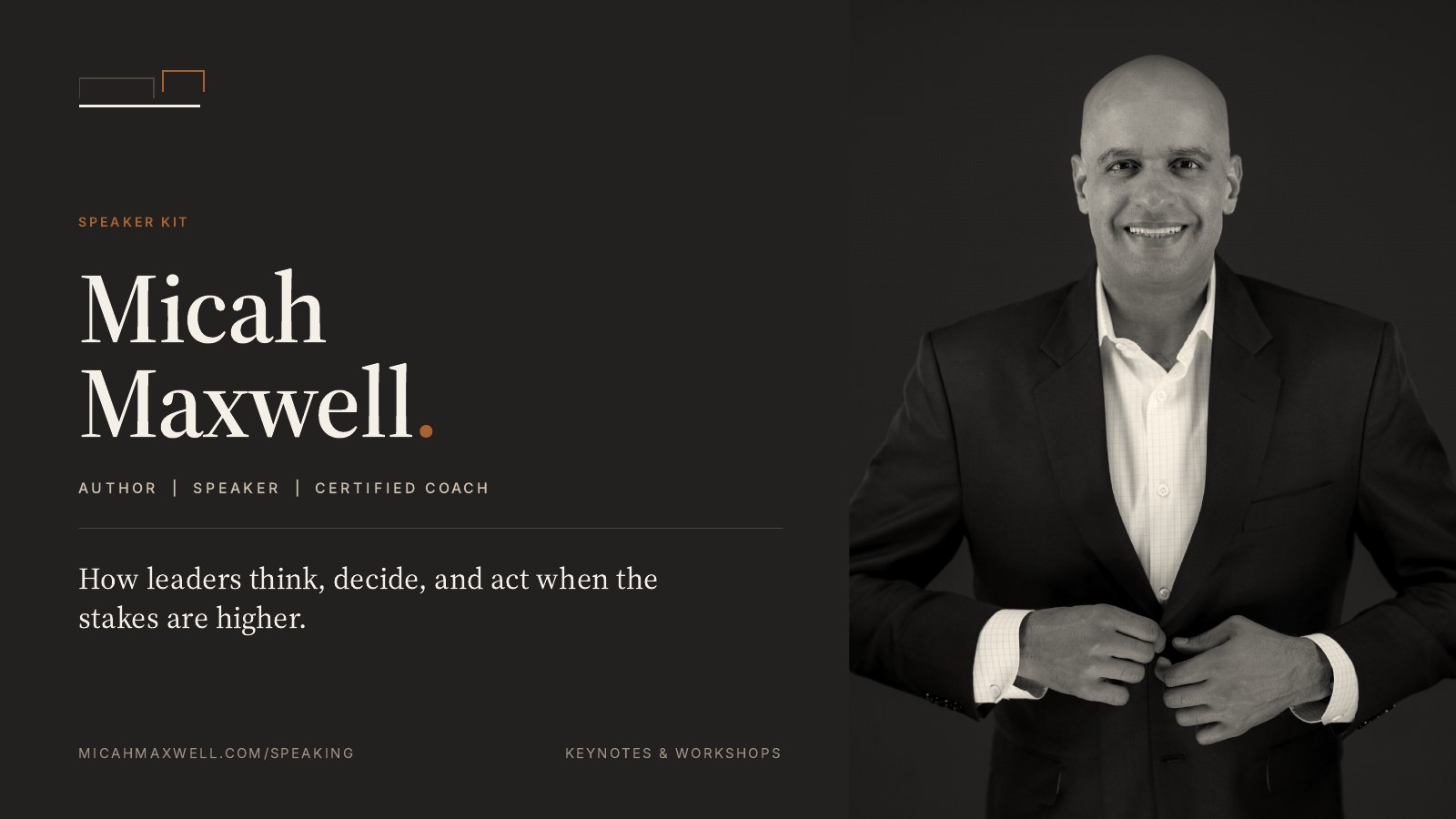
The Speaker Kit, on screen or on paper.
Most speaker decisions are made by two to five people, and you are the one who has to make the case. Six pages: the problem, the signature talk, the bio, what people say, how to reach me. Open it now and forward it. When you write to me below, a printed copy goes to your mailing address within the week, with a handwritten note on top.
Open the Speaker Kit (PDF) Web version
Mailed after you write, no purchase attachedFees on request. Terms that fit the room.
Tell me the budget you are working with. Some rooms pay a fee. Some rooms are worth being in for other reasons, and I will say which is which.
Every booking includes
- A 20-minute call about your audience before anything is agreed
- A pre-event questionnaire that shapes the open and the close
- The talk, adjusted to who is in the seats
- A note to you within 48 hours, with a two-question evaluation
- The Speaker Kit, mailed, for the people who were not in the room
Tell me about the event, the audience, and the date.
I will tell you within two business days whether I am the right person for it.
Two minutes on why me, before you write.
Received, thank you.
Here is what happens next.
- Within two business days you get a straight answer on fit, from me, not a form.
- If it fits, we book twenty minutes to talk about the room.
- The Speaker Kit goes in the mail this week, with a note on top.
While you wait, the book is the front door: Decision Point.
Fair questions. Straight answers.
Straight answers, in order of how often I hear them.
"Will this be another generic leadership talk?"
Two programs, one subject, and a questionnaire before the event that puts your room's language into the open and the close. If I cannot make it specific to your audience, I will say so on the call and decline the date.
"We do not have a speaker budget."
Say so in the form. Some rooms are worth being in for reasons other than a fee, and I will tell you plainly whether yours is one of them. What I ask for in exchange is usually simple: the recording, and a few minutes at the end to offer the room something free.
"Our audience is not executives."
The Stability Illusion does not check titles. Managers, founders, nonprofit directors, and people two years into a role all carry a decision their success is protecting. The examples change. The method does not.
"Does this work virtually?"
Yes, and the writing exercise works better on camera than most people expect, because everyone has a keyboard in front of them. Both programs are built to run on Zoom without losing the part that matters.
The details.
How long is the keynote?
Forty-five minutes. A sixty-minute version adds Q&A. A ten-minute version exists for openers and panels.
What happens after I write?
You hear back within two business days with a straight answer on fit. If it fits, we book a twenty-minute call about the room. Nothing is agreed until we have talked.
How much notice do you need?
Sixty days is comfortable. Shorter is possible; ask. The questionnaire needs two weeks before the date to shape the talk properly.
Do you travel?
Yes. Based in Washington, DC, and I travel nationally and internationally. Travel is quoted with the fee, not added afterward.
Can we record it?
Usually yes, and for some rooms the recording is part of the arrangement. We settle it on the call.
What do you need on the day?
A microphone, a clock I can see, and either a screen for one deck or nothing at all. The room needs something to write on.
Give them the words, and a path.
Tell me about the event, the audience, and the date, and I will tell you whether I am the right person for it.
Spring and fall calendars fill six to nine months out. If your date is inside that window, write this week.